

If you’re a CPG founder building a cult brand, you probably grew up on Meta. Now CACs keep climbing, and everyone from your board to the founder at the next table says you need to be on Amazon and TikTok Shop. But where do you start, and how do you know if they’re right for you?
To dig in, we gathered a room of CPG founders and operators at BBGV last week, co-hosted with our friends at Left Lane Capital and BrandProject and supported as always by Silicon Valley Bank. Around the circle: Lalo, Ultra, Pair Eyewear, Behave, Starface, Fishwife, Blueland, Unbound, WinkyLux, Washwise plus one of the sharpest Amazon agencies in the business.
The consensus: every channel has its pros and cons. None of them is a silver bullet, and none of them work alone. As Ankur Goyal, CMO of Ultra (ex-Coterie), put it, “TikTok Shop loses money” and “Amazon makes money” are both wrong. Channels that look unprofitable on their own could be the ones creating demand, and the ones that look profitable may just be capturing it. How’s that for a funnel analysis?
🛒 Am I Ready for Amazon?
It’s not “Am I ready for Amazon?” It’s “Is Amazon already looking for me?”
Rob Cromer, CEO of Aisle 3, is just the guy to answer that. In the words of Lalo co-founder Michael Wieder, Aisle 3 is “the only agency I’ve never thought about firing,” and Rob has scaled brands like Lalo, Caraway, Away and Cozy Earth on Amazon. Seven years ago his job was convincing brands that Amazon wasn’t scary. Today he’s more often telling them they’re not ready. Ankur echoed him: Amazon is demand capture, not demand creation, and it tracks your upper-funnel spend.
The test: check Amazon’s Brand Analytics. If your brand or product ranks in the top ~1M searches, there’s demand to capture efficiently. In the top ~500K, get there fast, before a look-alike takes the sale. Lalo is a strong case study. They spent four years building the brand before launching on Amazon - only when they found their high chair ranks in the top 25K searches. Without that brand search, Michael at Lalo said, they would have been losing money on ads. Their focus now: efficient contribution margin, and understanding how Amazon demand fits alongside retail and DTC.
To 1P or 3P? Rob’s rule: 99% of brands belong in 3P (Seller Central).
1P (Vendor Central): Amazon buys wholesale and controls pricing, creative and purchase orders. It may not honor your minimum advertised price (MAP), and you’ll be lobbying for enough inventory ahead of the holidays.
3P: you still get Prime shipping through Amazon’s fulfillment centers while keeping control of pricing, creative, assortment and ad budgets. That’s the flexibility you want when you’re building omnichannel.
Multi-pack it. Ankur, first at Coterie, now at Ultra, uses assortment as a key lever, bundling for Amazon at a higher cost of entry than DTC (but at similar unit pricing) to maximize incrementality and minimize cannibalization. Rob agrees most products should be sold in packs, not singles. Not every product, of course: no one is buying a three-pack of high chairs.
Two more hot tips:
Separate branded from non-branded ads. Mixing them makes everything look great. Amazon Marketing Cloud (AMC) gives a truer read on incrementality.
Budget for brand protection. Get ahead of fighting counterfeits sold under your brand’s name. But note - Amazon’s Transparency program runs about $1+/unit all in.
📱 TikTok, TikTok, TikTok: Three Ways In
1. Founder-led TikTok Shop (Behave). Behave’s founder, Mayssa Chehata, went all in on content for 90 days in late 2024, and it worked unusually well: 90%+ of Behave’s Shop sales came from its own videos, while TikTok’s reps say most winning brands drive 60%+ through affiliates. The virality also helped land Behave at Target. The lessons still hold:
Volume wins. 4–5 videos a day to start.
Tell one story 100 ways. For Behave, it was the founder story.
Answer comments on camera, including the critics. They often become fans.
Spend on discounts, not ads, to drive first trial.
Don’t build on one algorithm. Organic reach has since dried up for most brands, and Behave moved its content engine to Instagram (more on that below). Founder-led organic can still work for some brands, but today it’s the exception.
2. GMV Max + affiliates (Ultra). This is the playbook for brands entering now.
Affiliates drive the Shop. Per TikTok’s own reps, most brands winning on the Shop drive the majority of sales through affiliates.
Affiliate creators are your wholesalers. Ankur’s view: they only promote products they can make money on, so they go where the sales are, the same way Target stocks what moves. The Shop is how they see you ranking, and how they get paid. Without it, they won’t come.
You can systematize scale. Tribe is a great way to spin up a large volume of creator content in a week, paying a percentage of revenue.
Watch GMV Max. It only spends when you hit your minimum ROAS. Miss it and spend drops to zero, with no alert.
3. TikTok without the Shop (Pair). Not every product is right for TikTok Shop, says Grant Goldman, VP Marketing at Pair Eyewear. Prescriptions can’t be sold on the Shop so they had to take a different approach. Pair has run an in-house creator network since 2019, driving TikTok demand to its site and retail partners.
What sells on the Shop?
Lower price points. Lalo’s high-priced items are a tough sell; cheaper products like its stainless steel bento boxes have done better.
Consumables with repeat. For a snack like Behave, discounting the first purchase paid off in strong repeat, even within the Shop.
Premium, with a caveat. Premium products can go viral, but expect a wave of “highway robbery” comments and plan for community management.
Across all three, expect gatekeeping. Sexual wellness, kids’ products and prescription products have all hit invite-only walls. A warm intro to a good TikTok rep goes a long way.
📸 Instagram Is The New Website
Behave’s founder: shoppers don’t find brand websites credible anymore. Instagram is where they come to get to know your brand, and Amazon is where they check reviews. When TikTok organic dried up, Behave saw organic reach rise on Instagram and moved to Instagram-first content. The main feed stays polished. High-volume, TikTok-style content goes into Trial Reels, which reach non-followers, and anything that hits gets moved to the main feed. It drives less direct revenue than TikTok Shop’s two-click checkout, but as Behave pushes into retail, keeping eyeballs on the brand still matters.
💬 Borrow Other People’s Megaphones
Lalo’s Michael: “Everybody else’s megaphones collectively is way larger than our own.” Lalo built its creator program in-house by treating creators like people, not a sales channel, and going wherever there’s influence: Instagram, “a room of moms,” anywhere. It seeds product generously, and it has a built-in UGC moment: mealtime, several times a day, when parents already have their phones out. When Lalo launched, it showed creators how a brand in its category could show up, and they followed its lead. And babies aren’t aspirational to other parents (everyone thinks theirs is the cutest); the lifestyle and the parent are.
Grant at Pair echoed that: they’ve been building their own creator network since 2019, and work with hundreds of creators a month, mixing affiliate relationships with paid content.
Many in the group are driving those community megaphones further with platforms like Tribe to recycle its best creator content into Meta ads for a pile of pre-tested angles.
🤖 AEO: Learn It Before You Outsource It
AEO matters, but it’s early, and no one in the room recommended an AEO agency yet. Michael’s advice: learn enough yourself to call BS. What’s working:
Write for models. Lalo added natural-language Q&A to every product page: what people ask, and the answers.
Get on the lists. Best-of lists and awards are what AI answers pull from.
Check the citations. AI answers in your category often cite YouTube. Some bots read creator captions but not transcripts, so captions matter.
Test the new stuff small. Reddit and OpenAI ads are both worth a modest budget.
On site structure, Swati Vauthrin, co-founder and CTO of Scout, a new marketplace for shopping, argued shopping agents choke on heavy sites, so strip back to plain, conversational text. Others argued rich PDPs still win because AEO works alongside SEO. Either way, agents are already reading your site.
⚡ Quick Hits
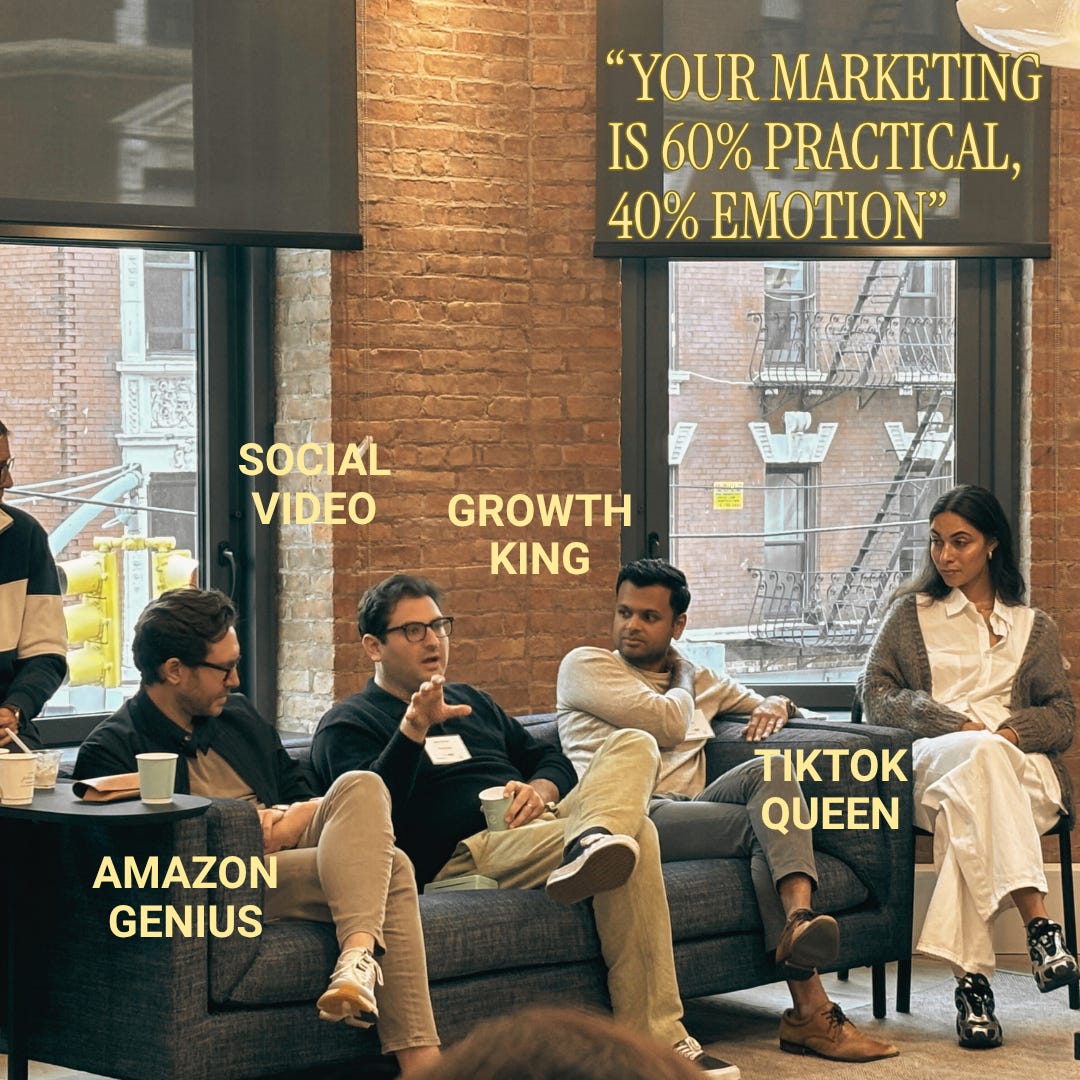
Nail the message. Ankur’s formula: roughly 50–60% practical, 30–40% emotional. At Coterie, the emotion was “Oh my God, I got to sleep.” Crack it and scale it, and it shows up as search velocity on Amazon.
Retail feeds Amazon and Amazon feeds Retail. Behave sees Amazon search spike with every Target launch or promo. Shoppers go there to check reviews.
Substack is still TBD. Many Substackers already push ShopMy links, so if you’re on ShopMy, ask them to feature you there too.
The takeaway?
Stop grading channels in isolation. Watch blended CAC, measure the halo, and let the fundamentals do the work: a message with real emotion, a lot of people who aren’t you telling it – and watch that contribution margin.
💰 What BBGV Is Looking For (in Consumer)
We invest on both ends of a barbell: deep technology and deep humanity. In CPG, deep humanity means brands built on timeless human needs, where emotion, taste and trust keep people reaching for a product no matter what AI does. We back the founders building cult brands that make you feel something, that are building a movement – especially the ones who understand how their channels feed each other. We’re also growing our CPG Club, so if you want in on the next breakfast, reach out at hello@bbgventures.com